

Operating a high-capacity wallboard manufacturing facility in arid regions, tropical zones, or desert environments presents unique thermal and chemical engineering challenges. When international building material producers operate a continuous линия по производству гипсокартона under extreme ambient temperatures—often exceeding 45°C (113°F)—uncontrolled heat can alter chemical hydration rates, accelerate premature setting in wet-end mixers, and stress delicate electrical systems. Designed to support annual output capacities strictly between 2 million and 50 million square meters per year, modern drywall facilities require specialized thermal regulation and dynamic process cooling. Drawing on decades of global plant deployment and engineering experience at Hebei Lvjoe Machinery Manufacturing Group Co., Ltd., implementing tailored high-temperature engineering protocols ensures consistent board core density, prevents equipment overheating, and maintains continuous 24-hour manufacturing productivity.
The continuous wet-end phase of wallboard manufacturing relies on a precise exothermic reaction between calcined hemihydrate gypsum, water, foaming agents, and structural additives. In hot ambient climates, elevated process water and raw material temperatures accelerate the crystallization process inside the pin mixer. Rapid setting before the slurry reaches the forming belt causes uneven core distribution, board edge voiding, and severe mechanical buildup inside mixing chambers.
Engineering teams at Hebei Lvjoe Machinery Manufacturing Group Co., Ltd. integrate automated inline water-chilling units and temperature-monitored slurry manifolds into the central Programmable Logic Controller (PLC) system. By regulating process water temperatures before entering the pin mixer, the production line maintains an optimal slurry temperature window, ensuring uniform foam bubble distribution, excellent paper adhesion, and flawless edge forming even during peak summer ambient heat.
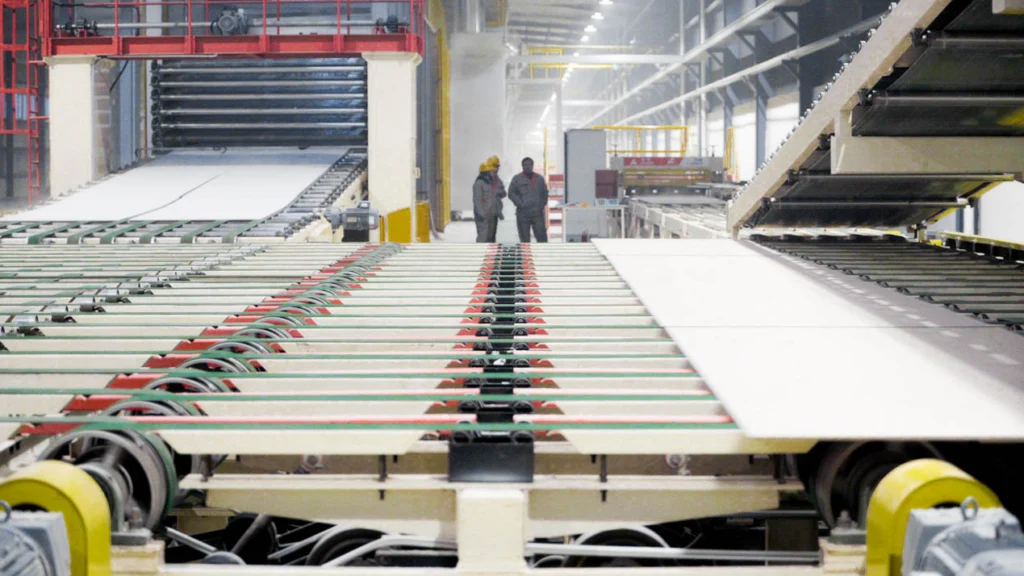
Extreme external temperatures combined with internal radiant heat from multi-deck thermal drying kilns place heavy thermal stress on delicate automation electronics, hydraulic drive systems, and heavy-duty gearboxes. Excessive ambient heat in control rooms can cause PLC processing units to trip, while high fluid temperatures degrade hydraulic oils, leading to pump cavitation and unscheduled mechanical downtime.
To ensure uninterrupted continuous operation in tropical climates, modern facilities feature positive-pressure, air-conditioned electronic enclosure rooms equipped with dual-redundant HVAC cooling units. Additionally, heavy-duty hydraulic stations and main drive gearboxes are fitted with external oil-to-water heat exchangers and continuous filtration systems. This protective thermal management framework prevents electronic failures, extends fluid service life, and safeguards long-term mechanical reliability across high-speed continuous manufacturing cycles.
In hot ambient climates, optimizing the multi-deck thermal drying kiln requires balancing internal moisture evaporation with ambient humidity and intake air temperatures. While hot ambient air reduces the thermal energy required to preheat burner intake air, unchecked exhaust humidity can lead to condensation traps in secondary exhaust ducts, compromising thermal distribution across drying decks.
Modern manufacturing lines integrate dynamic zonal temperature controls and automated exhaust recalculation loops. Advanced closed-loop heat exchangers capture clean exhaust thermal energy, recirculating heat while precisely balancing moisture extraction rates. This smart airflow management reduces total thermal fuel consumption by up to 30%, prevents board surface scorching, and ensures uniform core moisture removal regardless of shifting day-to-night ambient temperature swings.
Our heavy-duty wallboard production lines support annual output capacities ranging strictly between 2 million and 50 million square meters per year, tailored to local market demand.
High ambient temperatures accelerate chemical hydration in the mixer, leading to premature setting; we counter this by integrating automated inline process water chilling systems.
We deploy positive-pressure air-conditioned control enclosures with redundant cooling and equip hydraulic systems with external oil-to-water heat exchangers to prevent thermal tripping.
Copyright © 2026 Hebei Lvjoe Machinery Manufacturing Group Co., Ltd. All Rights Reserved. privacy-policy

