

Manufacturing high-grade Plaster of Paris (POP) requires strict physical and thermal control over raw gypsum rocks during continuous processing. Recently, a leading overseas building materials supplier contracted Hebei Lvjoe Machinery Manufacturing Group Co., Ltd. to engineer, construct, and deploy a bespoke plaster of paris making machine fleet. The primary objective was to expand regional processing capacity to supply high-purity molding plaster, architectural decorative elements, and plasterboard raw material substrates. Achieving uniform quality across high-volume production batches presented several technical hurdles, including raw material purity fluctuations, precise thermal retention during dehydration, and high energy costs associated with continuous thermal processing. Rather than purchasing standard off-the-shelf equipment, the client opted for a fully customized turnkey system built to accommodate local raw material characteristics and harsh operational conditions.
Raw gypsum rock must undergo uniform size reduction before entering the calcination phase. To achieve optimal input fineness, Hebei Lvjoe Machinery installed a heavy-duty primary jaw crusher and a high-speed secondary impact mill. Automated vibrating feeders control the throughput, preventing surge feeding and mechanical clogging. The crushed raw gypsum is then conveyed to a continuous vertical grinding mill equipped with a dynamic air classifier. This process ensures that particles reach a uniform fineness between 100 and 150 mesh, which is essential for consistent heat distribution during calcination. By controlling particle size early in the workflow, the processing line eliminates uneven core heating, lowers mechanical stress on moving components, and lays the groundwork for high-strength end products.
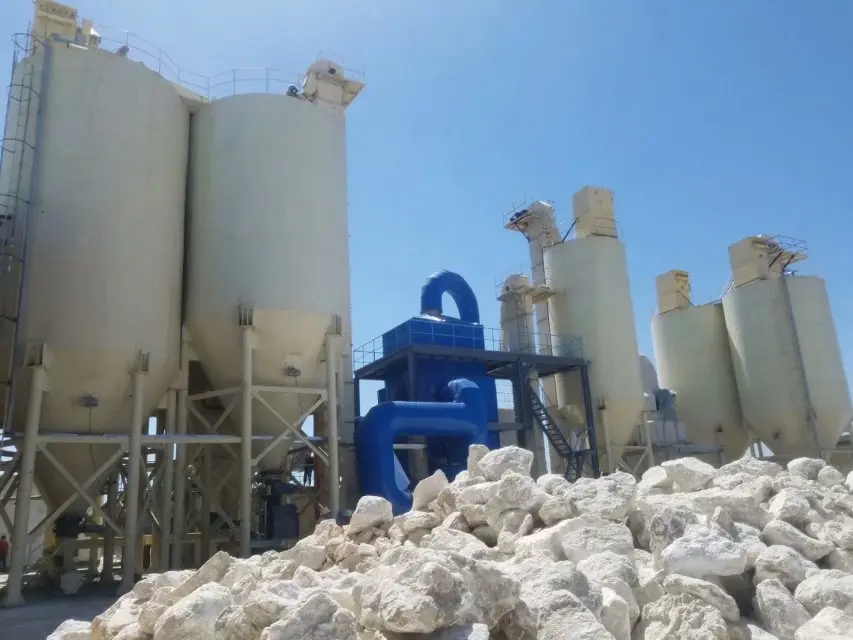
The performance of any plaster of paris making machine centers on its thermal calcination unit. For this fleet deployment, Hebei Lvjoe Machinery integrated an advanced indirect thermal oil ebullience calciner. Unlike traditional rotary kilns that operate with direct open flames, the indirect thermal oil kiln uses submerged heating tubes within a fluidized bed of pulverized gypsum. High-pressure air blowers fluidize the gypsum powder, enabling each particle to make contact with uniform heat between 150°C and 165°C. This controlled thermal profile converts raw dihydrate gypsum into stable, high-purity beta-hemihydrate plaster without causing over-burnt or under-burnt impurities. For complete specs on our automated systems, explore our primary plaster of paris making machine fleet solutions.
Industrial plaster calcination requires significant energy input. To support energy efficiency targets and comply with ISO 14001 environmental benchmarks, Hebei Lvjoe Machinery incorporated a multi-pass waste heat recovery system. High-temperature exhaust air from the calciner is captured and routed to secondary heat exchangers to preheat fresh process air and raw gypsum feed. The entire system is governed by a Distributed Control System (DCS) that tracks real-time data across key processing nodes. Closed-loop control algorithms adjust thermal oil valves, air blower velocities, and feeding speeds automatically. This minimizes direct operator intervention while maintaining narrow operational tolerances during continuous 24/7 manufacturing cycles.
Following installation and site acceptance testing, the customized machinery fleet reached target output capacity within weeks of initial startup. Laboratory testing confirmed that the finished Plaster of Paris met international standards, including ASTM C28 for casting plaster and EN 13279 for gypsum binders. The product showed consistent initial setting times, superior flexural strength, and smooth surface finishes. Partnering with Hebei Lvjoe Machinery Manufacturing Group Co., Ltd. provided the client with a streamlined project delivery, measurable fuel cost reductions of over 18%, and ongoing technical assistance supported by 24/7 remote diagnostics and priority spare parts dispatch.
Manufacturing, assembling, shipping, and commissioning a full custom equipment fleet generally takes 5 to 8 months. The precise timeline depends on specific output requirements, site preparation status, and international shipping schedules.
Indirect thermal oil calcination uses submerged heating pipes to transfer heat indirectly through a fluidized powder bed. This prevents direct flame contact, eliminates localized burning, ensures uniform phase conversion, and consumes significantly less fuel than direct-fired rotary kilns.
Hebei Lvjoe Machinery engineers its processing equipment to handle natural gypsum rocks as well as synthetic industrial gypsum byproducts, including flue-gas desulfurization (FGD) gypsum from power plants and phosphogypsum from chemical manufacturing.
Copyright © 2026 Hebei Lvjoe Machinery Manufacturing Group Co., Ltd. All Rights Reserved. privacy-policy

