

Bringing a large-scale commercial drywall production facility online requires a delicate balance between mechanical alignment, thermal calibration, and precise chemical metering. Recently, a major overseas building materials enterprise engaged Hebei Lvjoe Machinery Manufacturing Group Co., Ltd. to commission a high-capacity china gypsum board manufacture plant designed for an annual output of 30 Million Sqm (square meters). Transitioning a facility of this magnitude from cold mechanical testing to full hot-commissioning involves critical engineering hurdles. Engineers must prevent slurry setting variations, eliminate board thickness deviations at line speeds exceeding 60 meters per minute, and balance heat distribution across multi-tier drying chambers. Instead of purchasing fragmented machinery from disparate vendors, the client chose a unified turnkey engineering solution to secure rapid plant startup and guaranteed performance metrics.
The initial phase of commissioning focuses on the wet-end raw material blending suite, where raw calcined gypsum is converted into a uniform core slurry. Hebei Lvjoe Machinery deployed dynamic loss-in-weight feeders linked with automated liquid dosing modules. During site setup, engineers calibrated the high-shear continuous mixer to handle precise ratios of stucco powder, water, fluidizers, foaming agents, and bond-enhancing starches. Achieving the correct micro-bubble foam structure is essential; insufficient foaming increases board weight and raw material cost, while excessive or unstable foam compromises structural core integrity. By tuning the automated foam generator to inject uniform micro-air cells, the plant achieved a light yet durable gypsum core that adheres cleanly to heavy-duty protective paper liners.
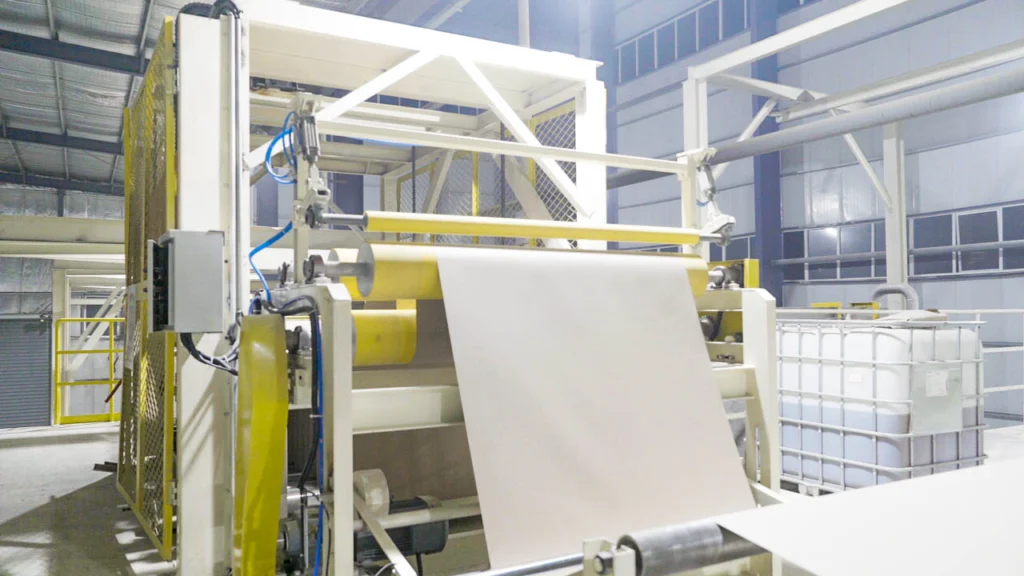
Once mixed, the homogenous gypsum slurry flows continuously between lower and upper protective paper sheets. To maintain uniform board thickness and clean edge profiles across continuous manufacturing runs, engineers fine-tuned the main forming station’s hydraulic calibration units. The continuous ribbon then travels along an extended setting belt conveyor system, allowing the stucco slurry to undergo controlled hydration and initial crystallization. Synchronizing line speed with chemical setting time is critical. If line speeds run too fast, wet boards arrive at the cutting zone under-hydrated; if too slow, early setting causes mechanical jamming. The engineering team adjusted variable-frequency drives along the belt to achieve complete crystalline bonding before high-speed flying shears execute clean, burr-free cuts.
After cutting, wet boards are automatically accelerated, turned, and distributed into a multi-deck drying kiln. Drying represents the largest continuous energy input in plasterboard manufacturing. During thermal commissioning, Hebei Lvjoe Machinery implemented multi-stage temperature profiling across distinct heat zones. High-temperature recirculating air removes free moisture without scorching the paper liner or causing core calcination. To optimize fuel efficiency, engineers integrated a proprietary waste heat recovery network that recaptures thermal exhaust air to preheat incoming fresh combustion air. For comprehensive technical specifications on our complete plant configurations, explore our main china gypsum board manufacture plant engineering systems.
Centralized process management is governed by an advanced Distributed Control System (DCS) that tracks hundreds of sensor parameters in real time. During final Site Acceptance Testing (SAT), engineers adjusted closed-loop automation loops to handle dynamic material shifts automatically. Field sensors monitor slurry viscosity, line tension, temperature gradients, and board density continuously. Within three weeks of hot ignition, the 30 Million Sqm plant achieved stable round-the-clock manufacturing at full capacity. Laboratory quality audits verified that finished plasterboards met international building standards, including ASTM C1396 and EN 520 guidelines for flexural strength, nail pull resistance, and dimensional stability. Partnering with Hebei Lvjoe Machinery Manufacturing Group Co., Ltd. delivered a smooth plant launch, reduced fuel consumption by over 15%, and provided long-term operational peace of mind supported by 24/7 cloud telemetry and dedicated technical field support.
Hot commissioning—from initial cold mechanical checks and dry runs to continuous full-capacity production and site acceptance testing—typically takes 3 to 6 weeks once civil erection and utility connections are fully complete.
A centralized DCS continuously monitors key variables like water-to-gypsum ratios, belt speeds, and dryer zone temperatures. Closed-loop algorithms automatically adjust feeder rates and heat valves, eliminating human error and maintaining consistent board quality.
Plasterboards manufactured on equipment engineered by Hebei Lvjoe Machinery comply with global standards, including ASTM C1396 (North America) and EN 520 (Europe) for core density, edge profile precision, and fire-resistant structural performance.
Copyright © 2026 Hebei Lvjoe Machinery Manufacturing Group Co., Ltd. All Rights Reserved. privacy-policy

